This study year (2017/18) is already the 5th iteration of running the Business Process Modeling course at the local university. And while the curse evolves with each iteration, its technological basis remained the same during the past years, namely BPMN 2.0. The main objective of my Business Process Modeling course is that the students attain a …
Report from my BPM/BPMN adventure in Istanbul
It was almost an instant decision accepting an offer to prepare a BPM/BPMN workshop for a life-insurance company, located in 15 million metropol Istanbul. And I didn't regret it, in any case. How it all begun In February I've been contacted by Nobleprog, a global training and consultancy provider, if I would be prepared to …
Continue reading "Report from my BPM/BPMN adventure in Istanbul"
Business process modeling with BPMN
While there was so much interest for downloading my presentation entitled "Business process modeling with BPMN (2nd edition)" on SlideShare, I've decided to open them (at least temporary) for the download. Many thanks for making the slides so popular. They are the first result of the SlideShare search with the keyword 'BPMN' and have been …
Interested in BPMN? Check these White Papers
If you are interested in topics related to business process modeling with BPMN, you may check white papers I've authored for Orbus Software. And here are the abstracts of the whitepapers. Modeling transactions with BPMN 2.0 Do you need to model business translations in a standardized way? Check this white paper! Similar to databases, transactions …
Continue reading "Interested in BPMN? Check these White Papers"
How to document processes beyond the workflow?
The web is full of guidelines and templates on how to document processes. However the majority of them is partial - related to the description of the workflow-related information only (e.g. process activities, process boundaries, process inputs and outputs, process roles, etc.). Process documentation is more than just a process diagram. There is process-related information …
Continue reading "How to document processes beyond the workflow?"
Do you prefer learning by video? Check this BPMN stuff!
Are you interested in business processes and the corresponding ISO standard - BPMN and do you prefer to learn by videos instead of slides? And you have only two minutes of time per day? In this case I recommend you to watch Orbus software's BPMN Distilled series of short videos, which give you a good foundation …
Continue reading "Do you prefer learning by video? Check this BPMN stuff!"
Hello “Summer semester”
While having record low temperatures of the season, the summer semester starts today at University of Maribor. This semester I will provide the following lectures: Business Process Modeling (1st Bologna stage on ICT study program). Business Process Management (2nd Bologna stage on ICT study program). Empirical Research Methods (2nd Bologna stage on ICT study program). While …
Processes First
Today, a focal theme in one of Slovenia's main daily newspapers Večer is related to business processes. The article entitled "Working processes are the most neglected part of public sector" (slo. "Delovni procesi so najbolj zanemarjen del javnega sektorja") the interviewed public employee and expert mag. Mario Plešej states the following (translated from Slovenian language) : …
A decade of BPMN poster
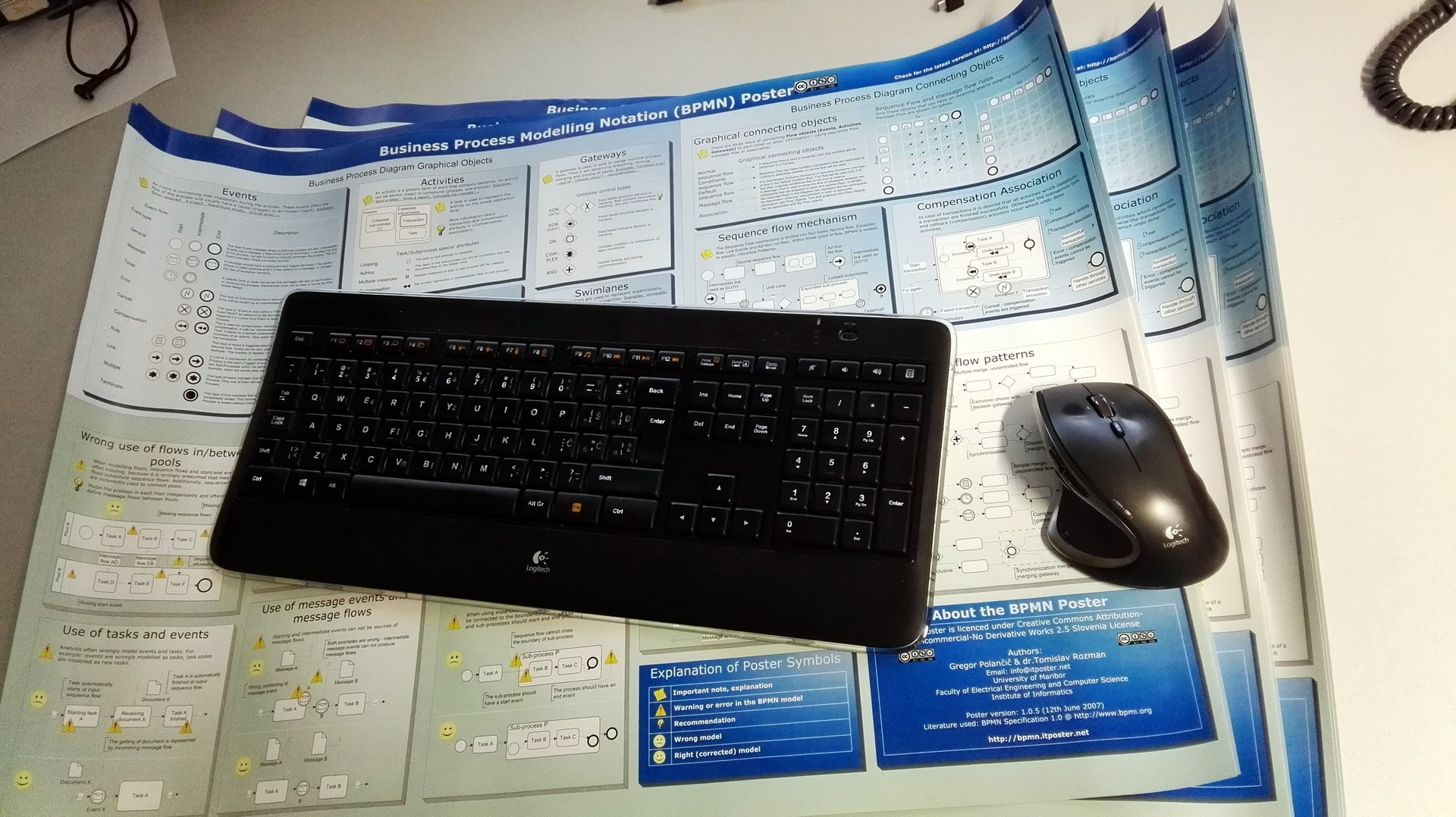
Ten years ago, in 2008 I was already investigating BPMN and I realized that beside the BPMN specification and some research articles, there was a luck of simple learning materials. Together with my colleague Tomislav Rozman, we've decided to create a poster which presented BPMN notation as well the best and worst practices of using …
How does a process look like?
Business processes are an essential part of each organization since they represent a template describing how organizational activities (and other assets) are interrelated in order to produce an outcome (i.e. products or services). Thus, processes are important organizational assets, however in contrast to materials, tools or infrastructure, they are intangible, representing an abstraction of instances …